Thursday, July 28, 2011

Garde Manger Mad Science

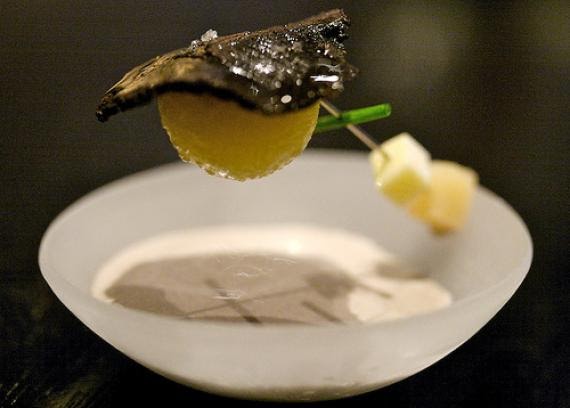
Of all the things that I have learned already this semester, Molecular Gastronomy is by far the most interesting.  It is the mad scientist version of the culinary world.  It pushes the boundary of what is commonplace and uses the most innovative method of cooking at the forefront of cuisine.  What started as a desire to apply scientific methods to the common cooking experience, ended in the development of new and cutting edge cooking techniques?  Whether one is making some desert foam that is to be dipped in liquid nitrogen, or a pseudo- caviar out of some sort of fruit juice, this type of cuisine isn’t for everyone, from a cooks perspective…  The better the cooks knowledge of the scientific processes that are happening, the better the chances of success.  Most culinary students would be able to use agar-agar to congeal a tomato reduction into a solid noodle form.  However, I doubt that the average culinary student would   be able to operate a rotary distiller to extract the essence of a chili pepper.  Beyond that, if you understand the nature of what you are trying to do, you should most likely succeed.  This method takes what we know scientifically and pushes as far as it can.  Conferences for molecular gastronomy have included acts such as cooking a sausage by bridging it across a battery pack and whipping a meringue within the confines of a vacuum.  The discipline that was supposed to tell us something knowledgeable about cooking and its methods has proven to develop methods, in and of themselves, which each have their own science.  The cooks seek to know something about their food and the future of cuisine is born.   If the culinary community continues to be curious, who can imagine what method will arise next, and what effects it may bring.

Thursday, July 21, 2011

Sausage

Today in Garde Manger class was a day of chilling, mixing, curing, grinding, and stuffing. Yes you guessed right today was sausage making. What an art this is, taking those casing and stuffing them with all types of delicious flavors. I truly have a fond appreciation for this. Not only did I reinforce skills that I haved learned in meat fabrication class, but now able to have a much deeper understanding of flavors and what mesh's well with various flavor profiles. I must say I enjoy Garde Manger class, it is my favorite class this semester, although it is the only lab class on my schedule, which might have something to do with why I enjoy it so much. It has and continues to be extremly rewarding with new information.

Thursday, July 14, 2011

Seasonality

 Today is session 3 and I have a presentation today of Seasonality. I will also be the manager (M.O.D.) for today.

            Today started off with Chef Anderson lecturing the class over vinaigrettes. This is the start of Chapter 2 titled “Cold sauces and cold soups”. Sauces and soups are among the first true tests of a chef’s skill. For the garde manger, the ability to produce perfectly balanced vinaigrettes, subtly flavored and creamy mayonnaise sauces, and cold soups of all varieties is a skill that should be constantly honed throughout a career.
             That is food for thought, but today my presentation went really well. I informed the class about the importance of knowing your menu items so that come time to order you will know what is in season and where it is in season (part of the country and world). I showed a map that had all the states titled along with what is in season. This map is a great tool because it provides you with the ability to go month to month so that you can effectively have a menu in line with the availability of food items.

  Seasonality Chart - Vegetables

Click on the name of a vegetable to see which farms grow it and what varieties are sold at the market. Please remember that harvest season is never exact. We have done our best to give a general idea of when certain crops can be found in the market, but every year is different, and different varieties have different harvest times!
Dark green indicates that a product can be found at the market, and is being harvested.
Light green
indicates that it can be found in the market but is not within its natural harvest season (possible through storage or hot house production).

Sunday, March 20, 2011

In the BUFF

Second day of class turned out to be a lot like the first. As acting Manager of the Day (MOD), I had a different view of the classroom as a whole, working individually with each group. Another mystery basket was assigned today, again with 2 proteins, 1 starch, 1 vegetable and 1 sauce. The proteins were venison loin, red drum, guinea fowl, and bay scallop. Throwing most of the dietary restrictions we had on day one out, we couldn’t produce anything with lactose (aka no dairy). This did not turn out to be a problem for most groups.


Following a brief class presentation on the American Culinary Federation (ACF) membership from the ACF student chapter President, Chef England gave a great presentation on B.U.F.F. (Balance, Unity, Focus, and Flow). The presentation encompassed the four different aspects of plating and creating show platters. The eye naturally follows a pattern known as the Fibonacci sequence. It is similar to the shape and structure of a conch shell, starting in the middle and spiraling out and around, forming a large circle. The four different aspects of plating all play a role in creating this natural design that makes something like a show platter look so beautiful and appealing to the human eye. As MOD, I had to work with all groups to help make sure they were achieving this in their plating.

As we started the mystery baskets, each team diverted in their own direction, all creating something completely different from the other. As the deadline approached, we had the room set up beautifully, with lined presentation tables and clean ranges and table tops. The outcome of today’s production was drastically different from the day before, with each team learning from their mistakes, focusing on the four components of B.U.F.F. 

If our production improves the same way each class, I cannot wait to see what we are able to produce at the end of the sixteen weeks!

Wednesday, March 16, 2011

First Day Twist

Garde Manger, a French term meaning “Keep to eat” originated in pre-revolutionary France, which was a time when controlling stock in food was like controlling stock in petroleum.  Day 1 in Garde Manger class started as most new classes start, everyone comes in, finds their seat, maybe talk to a friend, and then the professor comes in and its syllabus time. Unfortunately this is just how every class starts; there is just no better way to talk about rules, dates, and expectations. But this was the first time where the “get to know you” game was a two-hour mystery box activity. Each team had to produce a buffet/banquet style platter featuring two proteins, one vegetable, one starch, and one sauce. Easy enough, even considering it was all to be served cold.  But then we learned that no dish could contain any gluten, dairy, or sugar. Most of us had a tad bit of trouble with our palette reprogram. It was really interesting as to how all the students solved the problem. Weather it was sauces without starches, or creamy with no dairy, it was interesting to see each one. At the end of the day however, the general feeling is that this will be a good class.

Monday, December 13, 2010

Know your Farmer, Know your Food

Today in class I learned a lot about some of the different aspects of organic foods and more specifically organic farming. I thought I did a decent job with my research that I put into with the presentation but there were a couple of key elements that I left out. One specific part that Chef pointed out that does not really apply to the chain supermarkets selling organic produce. The “know your farmer” phrase can and still does play a major role in some of the most highly respected restaurants in the US and buying organic can mean that I am purchasing a superior product than that of a conventional item. I learned that through proper practices in organic farming the soil becomes rich in nutrients and will end up producing a better and more satisfying product.  And, the word "organic" on a label does not always mean that the farm is using proper practices to develop nutrient rich soils.

            Also in class today I learned a lot about the difference between composed salads and the regular salads that I would see served at a lot of the chain restaurants in Indianapolis. I was one of the people that took the practical final and had no idea about any of the base, body elements (probably because I never had Chef England) that any salad served at a restaurant is supposed to have. My thoughts before were always lettuce and then you throw some raw vegetables on top and overload with dressing. Appetizing? Absolutely not. So, producing these salads today gave me such a better perspective on how a true salad should be composed and how there should be thought and careful critique as an end result. I really enjoyed setting up the room today and I was very appreciative to see the time that all of us put into trying to make each plate look good.  At the very least, it was certainly better than any house salad I have forced myself to eat at our (insert chain restaurant name here)!

Thursday, December 9, 2010

Preservation of Seasonal Foods

Man has been preserving food since the beginning of time. Curing and drying were the most common ways to preserve fruits, vegetables and meats. In the Medieval days they used a method called dry-salting where the meat or fish was buried in salt and they also did brine-curing where meat was soaked in salt water. Today we have more hi-tech methods of food preservation such, as vacuum packing, and irradiation, which is exposing food to ionizing radiation. Yesterday in my Garde Manager class Chef England brought in a load of vegetables from his garden, there were three types of tomatoes and some peppers. We had the opportunity to preserve these vegetables using three different preservation methods. The preservation processes we used were drying, pickling, and canning. I helped with pickling the peppers; I can’t wait to taste them. Since I have been a student at Ivy Tech I have been introduced to the new movement of” buy local” and grow your own food. I have never grown any thing in my and I find this exciting and I would like to start my own small garden. I have also started buying from local farmers personally and I have encouraged my employer to add local products to our menu.
            I think that the reason for a lot of the health issues and obesity in this country is due to the fact that when America became industrialized we became a country that needed convenience. As technology has grown the quality of our food has decreased, we need to get back to the basics. I want to get down on my knees and get my hands dirty growing and preserving my own food and teaching others to do likewise, instead of eating at fast food restaurants and grabbing the prepackaged meal.

Monday, December 6, 2010

It was a busy night, discussing making cheese, preserving seasonal foods, and trying to catch up on everything left over from our charcuterie. I learned quite a bit and am really looking forward to putting it all into use in my career and at home.
                        The first part of last night dealt with the discussion of making cheese. This was my responsibility. I gave a short PowerPoint presentation on the history of cheese, the history of rennet – a  crucial ingredient in making cheese – and briefly covered the production process. I would have discussed that more, but I had arranged with a professional cheese maker to come in and discuss the actual methods they use in production. According to Chef, their company – Swissland Cheese – is one of the largest privately owned cheese makers in Indiana. I was very impressed with their operation, and also with the level of interest shown by most of my classmates. (I have to admit I was also very impressed with their “chedda feta blue” cheese!It was funny to me, when I walked them out afterwards, how impressed they were with my presentation. They were also very impressed with the other presenter, and her presentation on preserving seasonal foods.
            The other person's presentation covered the different methods used in preservation, such as canning, pickling, drying and jellying to name a few. It was very interesting to learn just how easy it was to do many of these. I knew about jellying, as I make jams and jellies at home nearly every year, but I learned a lot about canning other foods, like the use of a pressure cooker being necessary for the canning of low acid foods. Now, I know what to ask for at Christmas!
            I would love to say the most important lesson I learned was related to any of these subjects, but unfortunately that was not the case. The most important lesson I learned had to do with people. I learned that one negative attitude can ruin the pleasure of learning.  As a leader, it is a true challenge to harness peoples positive energy.  However, on a more positive note, I also learned that most of my classmates are supportive, encouraging, truly friendly, and that they honestly enjoyed our discussions yesterday.

Thursday, December 2, 2010

Smoking...Food

I learned that the white smoke is a suspension of water droplets. Once a meat forms a pellicle the water droplets then have something to cling to. After I sat and thought about the research I had done on smoking and the use of liquid smoke, it really made a lot of since to me as far as the smoke being water droplets which contains the smokey smell and flavors in them that adhere to the product being smoked. This is the same process they use to manufacture liquid smoke. I also learned that there has to be two openings or flutes when smoking. The purpose of this is to have a continuous air flow and to prevents standing smoke which would cause carcinogen that are harmful to us. I did not know that machine smokers also use liquid smoke. I was surprised to find out that most of the smoked foods that I had eaten was the product of liquid smoke. I also learned that the pellicle is actually a good bacteria that forms around the meat. The purpose of the pellicle is to give the smoke something to stick to, drys the outside and keeps inside moisture and to prevent the fat from reaching the outside, which can cause spoilage.
When doing a platter for presentation I learned that it is very important to use gelatin. The gelatin will provide a nice glossy look to the platter and it will help to hold the foods shape. I personally have never used gelatin before so I am looking forward to learning how to use them correctly to help with my platter presentation. As far as the platter its self, I believe most of the class is still having a little difficulty determining the difference between some vegetables and starches. I think the class is finally starting to catch on to having a theme as well as a flow to the platter presentations. To me it's a little difficult sometimes because it's all about how each person views and interprets the setup.

Tuesday, November 30, 2010

Smoking and Curing

News flash, finally the sausages got stuffed in class. It was a trying night with burst sausages and a girder not working right, but in the end the sausages got stuffed and the brining got done. There was a lot of different size sausages, I thought the smell of the Cajun Andouille sausage was amazing I got to try it earlier when I was taste testing. As you see in the picture some of the sausages had problems while stuffing the sausages. I had some trouble as Manager of the Day (MOD) I have not been a MOD for a long time. It was interesting to say the least; I have never done stuffed sausage before. We learned a lot about stuffing sausages and curing meats. We learn about different kinds salts like curing salts, such as Tinted Cure Mix (TCM) and the dangers of using too much of the TCM. We learn about dry salt curing and brining which is wet salt curing process.  We also learned about smoking, and the benefits of cold smoking and hot smoking, like how cold smoking makes meats store longer, where as hot smoking makes the meat ready to eat.  We learned how smoked items and some salted have to be air dried and aged for periods of time. I learned a lot about hams and how to make pancetta, Duck Confit, Gyro Meat, and Prosciutto. It’s been a lot of fun to learn as much as I have and I look forward to learning more.

Monday, November 22, 2010

Stacked

In class today we studied the making if sausages and we also looked at the final product from session three terrines. As a whole we learned several things about our terrines. In two of the groups the terrines where baked in a route. We learned that if the stack hole was not large enough or if there is not a stack hole at all there will be separation of the terrine and the croute. This was the case in one of our terrines as the stack hole was not large enough and the steam could not escape causing the terrine to rise and leave a gap at the bottom of the terrine dish. We also learned as we where cutting and tasting our terrines that if you use vegetable you should put them in the oven to draw out some of the moisture. This would help make the terrine a little dryer and make it more stable. One of the best things that I learned is if your terrine is under seasoned or over seasoned it cannot be used. This I learned because one of my group’s terrines was over salted, even though it had a very good flavor this item could not have been served on a platter for a buffet. When doing terrines we learned that there are several steps that must be taken even though it is not in the recipe if these steps are followed you will have a much better product turn out of your hard work.
To continue with session four we prepped sausage to grind and stuff. Even though only one group managed to stuff a sausage, I think the biggest thing we learned as a class is that time management is very crucial during our production. I think we did however learn some very useful information in this session. We did learn that the making of sausage is not a one day job, because most of the sausage will have to cure for several weeks if not months. We learned that sausage can be made from several different animals and can be stuffed in many different ways as well as different products with the natural animal casings being the best.  In closing I would have to say the one thing I learned the most was on my buffet presentation, this meaning the flow of my food from the ladder to its overall presentation cannot just be thrown together at the last minute it really needs some thought put in to it to make it more appealing to the eye especially for you potential customers.

Thursday, November 18, 2010

Temptation

Day 3 of the two by eight Garde Manger class for the Fall Semester, and we’re already off and running. Without even missing a beat from two mystery basket tests, we tear (and puree and even grind) into what I consider the “meat” of Garde Manger, the Pate d’Terrine. When I saw the listings on day 1, I knew that I had to have this as my day, just for how important I view the use of forcemeats in my culinary life.

As soon as we got settled into class, and the presentation had ended, the entire class just kicked into high gear, immediately moving to the cart and working on getting their pates and terrines (and even moussalines, depending on what was going on) ready for placement in the ovens and to sit overnight. While this was the core of today’s class, we still had to prepare the family meal for ourselves and our comrades-in-arms, the Baking Science students in the adjoining lab.

Unfortunately, that’s where we had our little hiccup. With such focused determination on not wanting our pates to break, to get them in the oven on time, the concept of family meal fell a little on the back burner. Even still, after a 15 minute extension, and a little cajoling, we got that plated up, with all pates in the oven. The threat of staying till midnight averted. Once again, we prove ourselves to be the stuff of the upper-level culinary students, cleaning our stations as we went, and making sure that our dishes weren’t piled up. Even with a little hiccup, we’re able to be clean at all times.

Overall, the class performed admirably, and as the forcemeats went into the ovens, and later the blast chiller, I’m left thinking, why do I have to wait until tomorrow to taste the final product? What’s the old saying? Good things come to those who wait. I can already taste it.

For me, pates are always worth the wait.

Monday, November 15, 2010

Amuse

AH! Amuse, like a crayon to a child or paint to an artist, food comes to the crafty chef with many elements to “ Amuse’ or tickle the fancy of the culinist foodie.
Yes let’s feast our senses with sight and smells and to tantalize our taste buds with the fabulous colors and textures that do delight the eye as well as the palate. It’s also very challenging because it has no real boundaries besides being a bit or two. Where as a meal contains the same elements but the amounts are larger and follow a theme. The chef can keep from being bogged down because it’s a tiny morsel to please and is really so simple. As well as all that it’s very economical to work with. A pound of protein and a hand full of idea’s we can be on our way to pleasures we can share with each other.
Amuse also causes a reset of how we think of food. Forget heavy and know that light is king.
In thinking what we do with leftovers, let’s make Amuse. Besides how many uses of leftovers are there?
I can’t stress enough that the freshest ingredients are the most important but still allows us to raid the refrigerator for goodies and ideas.
One problem I discovered was experience goes a long way so it’s time to open our imagination.
Amuse, the Magic Lamp of the creative chef. 

Reggie Osbourne

Garde Manger

The students of Ivy Tech Community college take a 16 session class studying Garde Manger.  Classically the Garde Manger person in a kitchen would be somene that takes care of all cold food, charcuterie and butchery. 
The students were asked to write a statement about what they learned in class so that it could be posted to this site.

Enjoy